
17.87 €
Python - libraries for working with data
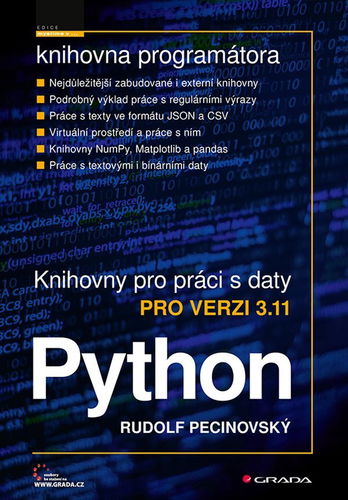
This new book from an experienced author is a loose follow-up to the successful textbook Starting to Program in Python, and therefore assumes the reader has a basic knowledge of this language. It does not try to be a data analysis textbook, but is conceived more as a reference guide, introducing the most important modules used when working with data and the possibilities for their use.
Among other things, you will find an explanation of constructs that are not normally covered in beginner courses, but whose knowledge is very useful when working with data. It introduces byte objects used when working with binary data, discusses working with regular expressions in detail, including new constructs added in version 3.11, data classes and the advantages of their use, and the issue of context managers.
It also deals with working with data stored in CSV and JSON formats: you will learn what pitfalls await the programmer when working with them and how they can be circumvented. Other topics include the principles and possibilities of pseudo-random number generators, including their use, or the Decimal data type, which allows you to work with large numbers where maintaining precision is important.
It also covers modules for working with time and the concept of a virtual environment, which allows you to work in parallel on projects with different required configurations of the tools used. There will also be the pip tool, with which you will install external libraries, and an introduction to working with the three most important data libraries: NumPy, Matplotlib and pandas.
Among other things, you will find an explanation of constructs that are not normally covered in beginner courses, but whose knowledge is very useful when working with data. It introduces byte objects used when working with binary data, discusses working with regular expressions in detail, including new constructs added in version 3.11, data classes and the advantages of their use, and the issue of context managers.
It also deals with working with data stored in CSV and JSON formats: you will learn what pitfalls await the programmer when working with them and how they can be circumvented. Other topics include the principles and possibilities of pseudo-random number generators, including their use, or the Decimal data type, which allows you to work with large numbers where maintaining precision is important.
It also covers modules for working with time and the concept of a virtual environment, which allows you to work in parallel on projects with different required configurations of the tools used. There will also be the pip tool, with which you will install external libraries, and an introduction to working with the three most important data libraries: NumPy, Matplotlib and pandas.
Whole description
Specifications
Basic
Author
Rudolf Pecinovský
Počet stran
320 pages
Rok vydání
2022
Nakladatel
Grada
Language
Czech
Format & type of protection
Available format
ePUB, Kindle (Mobi), PDF for ebook readers
Type of protection
Social DRM
All parameters
| Code: | EK43995 |
| Manufacturer information |
Grada Publishing a.s., U Průhonu 22, Praha 7, 17000 Česká republika, 220 386 401 [email protected] 
|