
Takstar PRO-38 Dynamic Microphone for Live Performances with 5m Cable
 Price Guarantee
Takstar PRO-38 Dynamic Microphone for Live Performances with 5m Cable
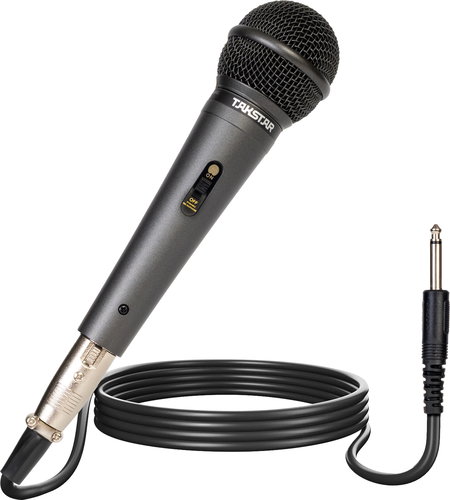
The Takstar PRO-38 Dynamic Microphone for Live Performances is a dynamic microphone designed for singing and moderating, ideal for stage performances, promotional events and outdoor activities. It features high quality workmanship, high durability and faithful sound transmission thanks to its wide frequency range of 60 Hz - 16 kHz. The cardioid characteristic effectively suppresses ambient noise, ensuring clear sound during live performances. It is made of durable zinc alloy and its metal grid has undergone a special heat treatment for greater protection against mechanical damage. The microphone has a sensitivity of -55 dB ±3 dB (0 dB = 1 V/Pa at 1 kHz), an output impedance of 600 Ohm ±30% (at 1 kHz) and dimensions of 51.6 × 170 mm with a weight of 329 g. It has a handy switch for quick sound control. Included in the package is a 5m 6mm diameter cable with metal XLR connector for reliable connection and a foam-lined box for safe storage.

In the hand (in the socket)
Microphone type
Dynamic
The principle of the microphone
Directional (cardioid)
Directional characteristic
60 - 16 000 Hz
Frequency range
Key features of the Takstar PRO-38 Dynamic Microphone for Live Performances, 5m cable
- Dynamic microphone for singing and moderating live performances
- Cardioid directional characteristic effectively suppresses ambient noise and ensures clear sound
- Wide frequency range for faithful voice transmission
- Durable zinc alloy metal design with a heat-treated grid for added protection
- Handy switch and 5m XLR cable for easy use on stage and outdoors

Suitable for singing

Technical specifications
- Sensitivity: -55 dB ±3 dB (0 dB = 1 V/Pa at 1 kHz)
- Output impedance: 600 Ω ±30 % (at 1 kHz)
- Operating voltage: 1,5-4,5 V
- Weight: 320 g
- Transmitter connector: 3.5mm jack
- Receiver connectors: XLR
- Dimensions: 50 × 50 × 170 mm (h × w × h)
Package contents
- Takstar PRO-38 Dynamic Microphone for Live Performances
- Connection cable 6 mm × 5 m (Ø × d)
- Gift box with foam filling
The principle of the microphone
The dynamic microphone is suitable for open performances, live input, music production, etc. It uses a magnet and a moving coil to capture sound.
You will use a condenser microphone mainly for studio purposes. It has higher sensitivity and lower noise. It is necessary to power it separately.
Frequency range
The frequency range indicates the range of frequency values that the microphone records. The higher the range, the more sounds it can record.
Low frequencies (e. g. 20–200 Hz): Bass, the deepest tones of instruments (double bass, kick drum) and male voices.
Medium frequency (e. g. 200–3000 Hz): The body of the instruments, the base of the voice, where the ear is most sensitive, important for speech intelligibility.
High frequencies (e. g. 3000–14000 Hz): Treble, detail, sibilance and " shine" of the sound.
Airband (above 14000 Hz): It gives recordings a sense of expensive, super-quality sound and space.
Sensitivity
Microphone sensitivity is the ratio of output voltage to sound pressure. It expresses how loud a signal a microphone produces at a given sound pressure; higher sensitivity means stronger voltage and is suitable for quiet studios, while lower sensitivity is better for noisy environments as it will amplify less ambient noise unnecessarily.
Specifications
Connection
Microphone characteristics
Features
Dimensions
Weight
| Code: | TKSTR01m7 |
| Warranty: | 24 months |
| Links: | Producer's Website: |